Translated with AI from the Russian original.

The global e-commerce market exceeded $6.42 trillion in 2025, driven by the development of mobile commerce, AI-powered personalization, and the growth of cross-border sales. Against this backdrop, the role of developing countries, including Uzbekistan, where digital trade is showing rapid growth, is strengthening.

Uzbekistan's domestic e-commerce market is estimated at $1.2 billion by the end of 2024, with a forecast to increase to $1.8–2.2 billion by 2027. Growth is supported by the expansion of the internet audience, which already numbers about 32.7 million users, as well as the development of digital payment services and logistics infrastructure.

International platforms play a significant role, including Wildberries, which has been operating in the country since 2022. During this time, sales by Uzbek sellers on the platform exceeded $1 billion, and exports to Russia increased by 63%. The company is also investing about $150 million in the construction of a logistics center in the Tashkent region, which further strengthens the online trade infrastructure in the region.


Now on the front page

Uzbekistan Airways will connect an AI platform to monitor competitors’ airfare prices

Uzbekistan Airways will connect an AI platform to monitor competitors’ airfare prices

The AirGain system will analyze airline fares and help promptly adjust pricing policy

Profit of Uzbekistan’s largest automaker plunged by almost half

Profit of Uzbekistan’s largest automaker plunged by almost half

UzAuto Motors’ net profit dropped by 46.9% in the first nine months of 2026, while revenue fell by 13.2%.

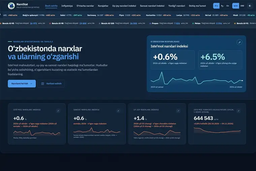
NarxStat launched in Uzbekistan — an open platform for tracking prices and inflation

NarxStat launched in Uzbekistan — an open platform for tracking prices and inflation

The service allows users to explore regional statistics and export data via API without registration.

Central Bank of Uzbekistan adopts Hong Kong and Malaysia experience to automate financial supervision

Central Bank of Uzbekistan adopts Hong Kong and Malaysia experience to automate financial supervision

The regulator studied data management platforms and electronic reporting systems.

Uzbekistan proposed that American investors establish IT centers and expand business in the country

Uzbekistan proposed that American investors establish IT centers and expand business in the country

Talks with representatives of the US Chamber of Commerce and international companies were held in Washington.

Uzbekistan to involve Seoul National University in developing artificial intelligence institute

Uzbekistan to involve Seoul National University in developing artificial intelligence institute

The parties agreed on joint research and academic exchange

“Yandex Maps” added panoramas of two cities in Uzbekistan and updated the streets of Bukhara

“Yandex Maps” added panoramas of two cities in Uzbekistan and updated the streets of Bukhara

The service received over 146 thousand new panoramas captured along 3,800 km of roads.

Uzbek language costs AI twice as much as English

Uzbek language costs AI twice as much as English

Due to tokenization specifics, processing identical content in Uzbek requires up to 2.17 times more tokens than in English.

Sun and wind provided nearly 10% of electricity generation in Uzbekistan

Sun and wind provided nearly 10% of electricity generation in Uzbekistan

Over ten days, renewable sources saved 63 million cubic meters of gas.

Pegasus Airlines will connect Istanbul with three cities in Uzbekistan at once

Pegasus Airlines will connect Istanbul with three cities in Uzbekistan at once

New direct flights to Bukhara and Andijan will open in December, and to Termez in spring 2027.

Russian IT investments in Uzbekistan triple to reach $320 million

Russian IT investments in Uzbekistan triple to reach $320 million

There are already 47 Russian IT companies operating in the republic, and trade in digital solutions grew by 64% over the year.

Japan’s SYSKO has proposed installing an autonomous power system in Tashkent Region

Japan’s SYSKO has proposed installing an autonomous power system in Tashkent Region

The pilot project is designed for six months and involves the use of a 100 kW generator and a 100 kWh battery