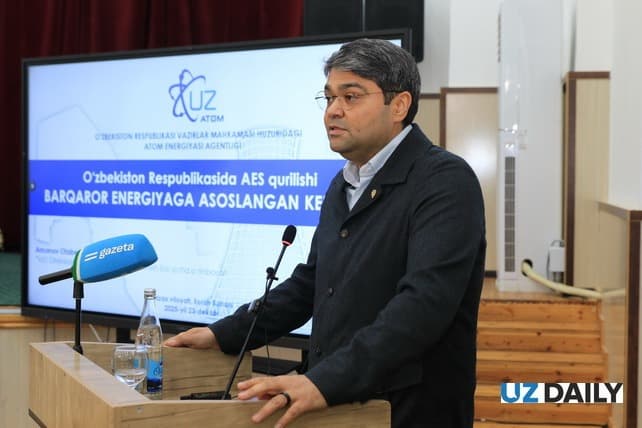
Uzbekistan is not ruling out the possibility of building a second large-capacity nuclear power plant. According to Azim Akhmedkhadjaev, Director of the Uzatom Agency, there are currently no official plans for this, but studies have shown that the selected site allows for the placement of additional power units, taking into account future growth in electricity consumption.
Initially, the integrated nuclear power plant in the Jizzakh region was designed with two large VVER-1000 reactors of Russian design. The updated scheme allows for an increase in their number to four, with the construction of two cooling towers for each power unit. The current plan still retains a combination of two small and two large reactors, but the expansion option remains in reserve.
In addition to the large power units, the site is planned to house a small modular reactor RITM-200N, as well as all related infrastructure - from a radiation monitoring system to 500 and 220 kV substations. The increase in nuclear capacity is included in the energy balance strategy until 2040: by this time, nuclear power plants should provide 4 GW of installed capacity and surpass coal-fired generation, turning nuclear energy into one of the key sources of electricity in the country.