A multi-lens telescopic complex designed for simultaneous observation of almost the entire sky has been put into operation at the Maidanak Astronomical Observatory in Uzbekistan. The project was developed by scientists from the Mirzo Ulugbek Astronomical Institute of the Academy of Sciences of Uzbekistan in cooperation with the Shanghai Astronomical Observatory of the Chinese Academy of Sciences. The system includes 31 independent optical modules and highly sensitive CMOS cameras.
The main task of the complex will be to detect and monitor fast-moving objects, including near-Earth asteroids, meteors, bolides, artificial satellites, and space debris. The real-time images are processed by 16 computers, generating 6–7 TB of astronomical data per day. A 150 TB system is provided for data storage.
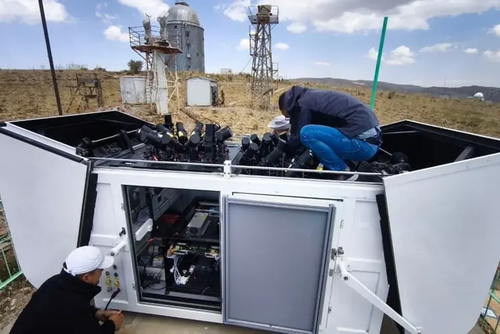
The telescope is equipped with deep learning algorithms that automatically detect moving objects, track their trajectories, and calculate preliminary orbital parameters. The complex can operate in automatic mode, plan observations, and be controlled remotely. The Academy of Sciences expects that the equipment will expand Uzbekistan's capabilities in monitoring near-Earth space and international space research.